What Is Number-Smart Learning?
Some children are naturally drawn to patterns, puzzles, and the way things fit together. They love to count, compare, categorize, and figure out why something works the way it does. This is the Number/Logic Intelligence — one of the most powerful ways young minds develop critical thinking.
You may notice your child is meticulous about their belongings — lining toys up by size, sorting objects by color, or insisting that things go back exactly where they belong. These aren't quirks; they're early signs of a brilliant logical mind at work.
A great strategy for this learner is to invite them to solve problems with you. Ask for their help, involve them in categorizing, and let them teach a sibling how they figured something out. Teaching reinforces mastery like nothing else.

Signs Your Child Is Number-Smart
Loves Fitting Things Together
They show curiosity about how puzzles and objects fit, and work patiently until all the pieces connect.
Organizes & Categorizes
They naturally sort toys, books, or foods by size, color, or category — even without being asked.
Counts Everything
They count steps, items on a shelf, people in a room — numbers are simply how they experience the world.
Notices Patterns
They spot repeating patterns in tiles, fabric, or sequences and often point them out with delight.
Asks "Why?" Constantly
They don't just accept how things work — they want to understand the cause behind every effect.
Meticulous with Possessions
Their room or play area has a logical order to it, usually organized by size or type, and they notice if anything is moved.
Strengths & Learning Preferences
Number / Logic Intelligence Profile
Core Strengths
- Counting & reasoning
- Logic & problem solving
- Finding patterns
- Cause & effect thinking
- Organizing information
- Mental math
Favorite Activities
- Solving problems
- Asking how & why
- Working with numbers
- Experimenting
- Classifying objects
- Puzzles & building
Learns Best By…
- Working with patterns
- Organizing & sorting
- Categorizing items
- Hands-on experiments
- Solving real problems
- Teaching others
A great way to teach the number/logic child is to have them research, classify, practice, and solve — then have them teach you or a sibling how they did it. Teaching is the highest form of learning.
Building Communication with Your Logical Thinker

Helping Them Use Their Words
Number/logic learners often prefer to think internally. They may not naturally volunteer how they feel or what they need. As a parent, your role is to gently draw them out — not with pressure, but with the right questions.
Say often: "Use your words." Ask: "How are you feeling right now?" Encourage them to name emotions — sad, excited, frustrated, proud — and praise them every time they do. This builds the emotional vocabulary that complements their logical mind.
Also model good manners consistently: please, thank you, I'm sorry, asking permission, and "Can I help?" These social-logic frameworks feel natural to this learner when framed as the right rules to follow.
Activities by Subject
Language Arts
- Say words distinctly and precisely — repeat them so your child hears the correct pronunciation clearly
- Encourage "Use your words" — prompt them to express needs and feelings verbally, not just through actions
- Ask them to name how they are feeling: sad, excited, mad, happy — build an emotional vocabulary
- Practice good manners as a daily routine: please, thank you, I'm sorry, asking permission
- Ask open-ended questions: "How are you feeling?" invites sharing; logic learners need the prompt
Math
- Prod with a question: "I wonder what would happen if I turn this?" — invite them to figure it out
- Introduce place value: the number 9 plus a zero (call zero a "place holder" — let them figure out why)
- Teach writing numbers 1–9 using straight, curved, and slanted lines — make it visual and fun
- Make concepts memorable: "The number 5 has a big fat stomach" — humor helps the logic brain encode
- Teach even and odd using playing cards or food — sort them into two stacks and compare
- Grocery store math: count people ahead, people behind, then add them together in the checkout line
Science
- Best taught hands-on — keep experiments simple, safe, and repeatable
- Seed on a wet napkin vs. seed in soil — observe and compare which sprouts faster
- Paper airplane experiment: flat paper vs. folded wings — which flies farther and why?
- Try two farming methods: sand vs. soil in pots or small pools — track which has the best yield
- Teach the scientific method: predict first, test second — remind them wrong results are still results
- Highlight cause and effect in everyday life — "I did this and it caused that" is their native language
Math Is Everywhere

The Grocery Store as a Classroom
The checkout line is one of the best math classrooms available — and it costs nothing. Ask your child how many people are ahead of you. Then how many are behind. Then have them count everyone in line and add both groups together.
This simple activity teaches counting, addition, and estimation in a real-world context that a logic learner finds immediately meaningful. Numbers connected to a real purpose stick far better than numbers on a worksheet.
Look for these moments everywhere: steps on a staircase, items in a bowl, tiles on the floor. The world is full of math — your job is simply to point to it and ask, "What do you notice?"
Hands-On Science at Home

Let Them Discover — Even When It Fails
The number/logic child is a natural scientist. Set up a simple experiment — seeds in sand versus seeds in soil — and let them make a prediction first. Which will grow faster? Why do they think so?
This teaches the scientific method: observe, predict, test, record, conclude. More importantly, it teaches one of the most valuable lessons for logical minds — that an experiment that turns out the opposite of what you expected is not a failure. It's data.
Search YouTube for "Science in a Nutshell" — a curriculum that works beautifully for most learning styles, especially hands-on logic learners. Document results with photos and a simple chart to make conclusions feel official and satisfying.
From Numbers to Careers
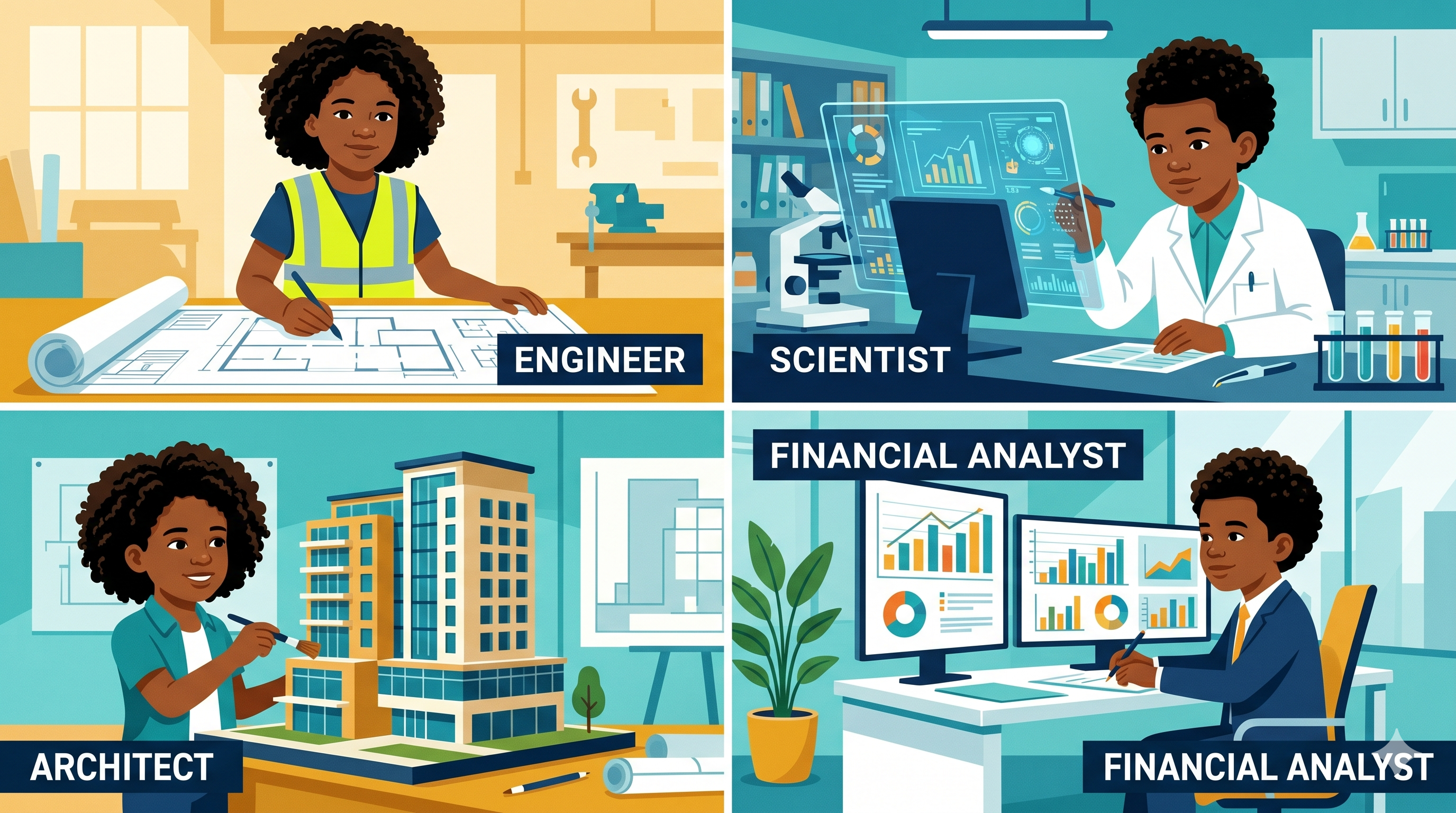
Career Pathways
Where Number-Smart Children Thrive
Children who love patterns, logic, and problem-solving often grow into professionals who build, analyze, and innovate. Their curiosity about how the world works becomes the engine of extraordinary careers.
The puzzles they solve today are the systems they'll design tomorrow.
Engineer
Scientist
Architect
Financial Analyst
Software Developer
Mathematician
Physician / Surgeon
Aerospace Engineer
Cybersecurity Analyst
Logistics & Supply Chain
Environmental Scientist
Biomedical Researcher